There are plenty of unusual buildings in Poland, but few look quite as though they have just touched down from outer space.
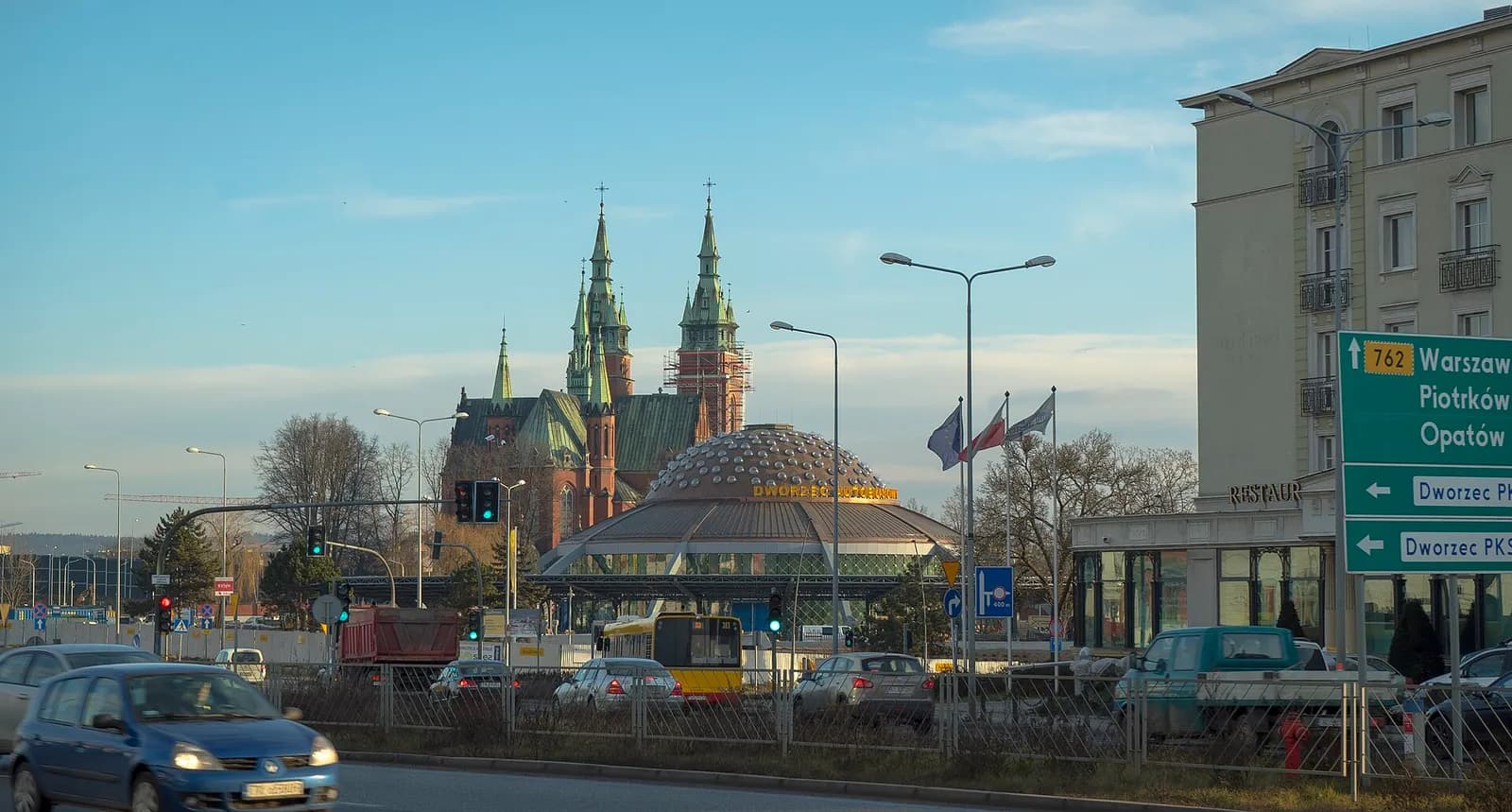
In the centre of Kielce, a huge circular building with a domed roof sits surrounded by buses. Locals have long called it the „kielecki spodek”, or Kielce's saucer. The more familiar nickname is simply UFO.
Officially, it is the Centrum Komunikacyjne, the city's main bus station. But its distinctive shape has made it one of Kielce's best-known landmarks.
And the story behind it is just as interesting as its appearance.
A futuristic idea from the 1970s
The station was designed at a time when Kielce was growing and needed a modern transport hub capable of handling large numbers of buses and passengers.
Construction began in 1975, based on a design by architect Edward Modrzejewski, working with engineers Jerzy Radkiewicz and Mieczysław Kubala.
The station finally opened on 20 July 1984.
Its circular shape immediately set it apart from conventional bus terminals. Three levels were arranged around a central rotunda, with buses travelling around the outside.
The design was not just about creating something that looked futuristic.
The circular layout helped organise the movement of buses and passengers, while pedestrian routes were separated from traffic, including through underground passages. The original station was designed for around 1,500 buses and 24,000 passengers a day.
It was practical architecture with a very distinctive personality.
From bus station to city icon
Over the years, the UFO became part of everyday life in Kielce.
For generations of residents, it was where journeys began and ended, where people met family members arriving from elsewhere in Poland and where commuters passed through on their way around the region.
Its unusual appearance also gave the city something instantly recognisable.
By the 2000s, however, the station was showing its age. The building and its infrastructure needed major investment, and its future became a subject of debate.
Eventually, the decision was made to preserve the landmark rather than replace it.
Saying goodbye before the rebuild
In September 2017, Kielce held a public „Pożegnanie dworca PKS”, or farewell to the bus station.
It was an opportunity for people to see parts of the building that were normally off limits, with exhibitions, concerts and tours organised before the reconstruction began.
The response reflected the affection many people had for the old station.
For a building originally designed as transport infrastructure, the UFO had developed a surprisingly strong place in the city's collective memory.
The UFO returns
Reconstruction began in 2018, and the new centre opened to passengers in 2020.
The project cost more than PLN 68.5 million, with European Union funding contributing to the investment.
Architects Marcin Kamiński and Bartosz Bojarowicz were responsible for the redevelopment following an architectural competition.
The aim was to modernise the building without losing the features that made it recognisable.
The circular structure and distinctive dome remained. So did the relationship between the central building and the surrounding bus platforms.
Inside, almost everything required for a contemporary transport centre was brought up to date.
There are modern passenger information systems, lifts, escalators and improved accessibility, including tactile guidance, Braille signage and audio information systems.
The building's glass façade also incorporates electrochromic glazing, allowing the glass to change its tint depending on conditions such as sunlight.
It is a fitting update for a building that already looked futuristic in 1984.
Look closely and you'll find the past
The reconstruction did not erase everything that came before it.
Several original elements have been retained, including a pillar, part of a bench and a section of wall incorporating broken Ćmielów porcelain.
These details are easy to overlook, but they give the renovated station a tangible connection with its earlier life.
The architects also retained the essential logic of the original design. Buses still circulate around the central building, preserving the visual and functional idea that made the station so unusual in the first place.
There's more going on inside now
The modern UFO is not only somewhere to catch a bus.
Part of the building houses a mediateka, providing library and reading facilities, while the Punkt Promocji Kielc offers tourist information and space for exhibitions and cultural activities.
Opened in 2021, the tourism centre has hosted exhibitions, educational events and presentations about Kielce and the Świętokrzyskie region.
It gives the building a new rhythm. People still pass through on their journeys, but others now come simply to use the public and cultural facilities inside.
An architectural landmark
The rebuilt station was among Poland's nominations for the 2022 European Union Prize for Contemporary Architecture – Mies van der Rohe Award.
That recognition is significant because the project demonstrates what can happen when a distinctive piece of 20th-century architecture is modernised rather than swept away.
The Kielce UFO has its roots firmly in the PRL era, but it has avoided becoming a museum piece.
Today, the familiar flying-saucer silhouette remains one of the first things that catches the eye around the city centre, while the building itself continues to perform the job it was designed to do.
See more: Museum of Toys and Play in Kielce: Where Childhood Becomes History
Image credit: AnalogIgor, Wikimedia Commons, CC BY-SA 4.0