A toy can be made for a child's imagination, but decades later it can also become a surprisingly revealing record of the world around it.
There are few museum collections that can make visitors think about the past through objects originally designed to be played with. In Kielce, toys provide precisely that opportunity.
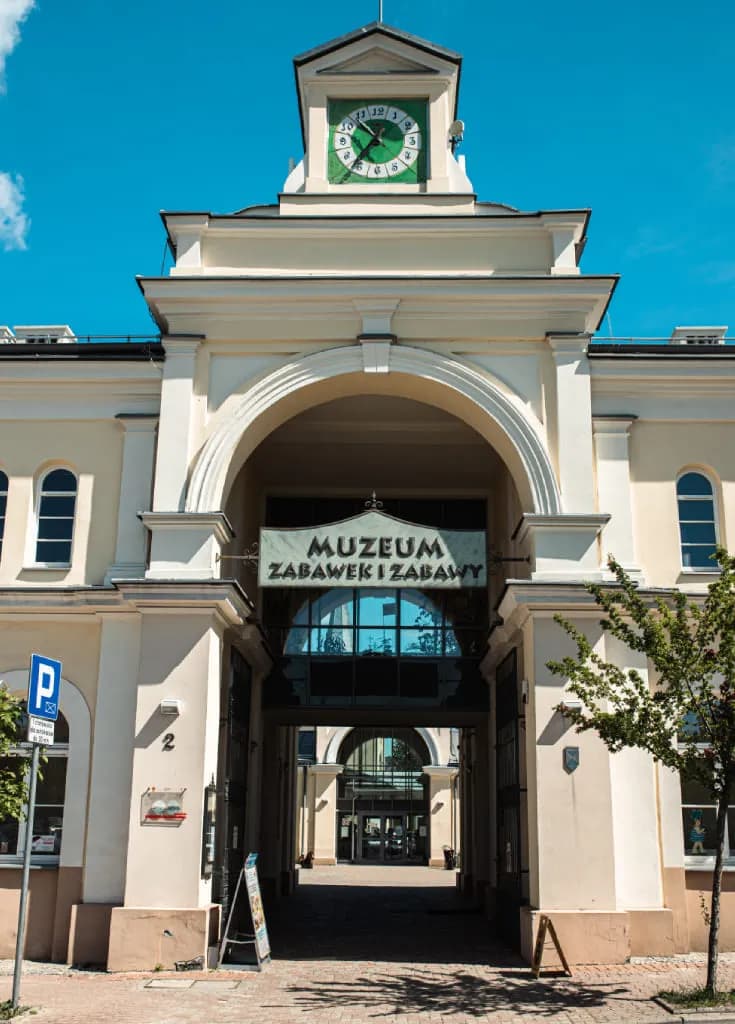
The Museum of Toys and Play is the oldest and largest museum of its kind in Poland, with thousands of exhibits displayed across 631 square metres. Its collection ranges from historical and folk toys to dolls, model vehicles, railway models and theatrical puppets.
For children, the appeal is immediate. For adults, the collection can offer something more reflective: a reminder that the toys of one generation can become the cultural history of another.
The museum occupies a nineteenth-century building that once formed part of Kielce's covered markets. Its historic setting adds another layer to an institution whose collections are concerned with how people, and particularly children, experienced their everyday worlds.
A collection that stretches far beyond the nursery
The museum's displays encompass a remarkably broad range of forms.
Dolls from different parts of the world sit alongside model cars, aeroplanes, boats and railway models. Historical toys demonstrate how play has changed over time, while folk toys provide a connection with local traditions and forms of craftsmanship.
The collection also includes theatrical dolls, opening another window onto the relationship between toys, storytelling and performance.
What makes these objects interesting as museum pieces is the context they provide. A toy reflects the materials available to its maker, the technologies used to produce it and the ideas surrounding childhood at the time it was made. Even a small object intended for play can therefore carry information about design, manufacturing and everyday culture.
The museum's approach recognises this dual role. It presents toys as objects to be examined while retaining the sense of curiosity and play that originally gave them meaning.
For younger visitors, interactive exhibitions allow them not only to look at selected objects but also to touch and engage with exhibits. There is also a play area, while during the summer the museum's courtyard provides additional space for play.
The story behind the collection
The museum itself has a history worth exploring.
Founded in 1979, its early development is documented in the exhibition The History of One Museum. Rather than focusing solely on the toys, the exhibition looks at the institution's own journey through documents, photographs, models, plaques, folders and material connected with its exhibitions.
Among the objects displayed in the museum lobby are toys produced by toy cooperatives that were shown at the institution's first exhibition in December 1979.
The display also reflects the role played by the National Union of Toy Cooperatives in the museum's creation. Its standard is given a prominent place in the exhibition, alongside historical material that helps reconstruct how the institution developed during its early years.
This makes the museum's history another story about toys, but viewed from a different direction. Instead of asking what children played with, it asks how a collection devoted to those objects came into existence and how the meaning of toys changed once they entered a museum.
A museum where play remains part of the experience
The balance between preservation and play is central to the institution's identity.
Museums normally ask visitors to look carefully but not touch. Here, selected interactive displays deliberately change that relationship, particularly for children encountering the history of toys for the first time.
The approach makes sense for a collection whose objects were originally created to be handled. The museum can introduce children to historical objects without separating them completely from the curiosity and experimentation associated with play.
There is also a small visual ritual associated with the building itself. Every day at noon, a Świętokrzyska witch emerges from the museum's clock tower. The sculpture was created by Arkadiusz Latos and installed on the tower by clockmaker Bonifacy Komorowski.
It is a fitting detail for a museum where the boundary between historical objects and childhood imagination is deliberately kept open.
The Museum of Toys and Play ultimately offers two experiences at once. It is a place where children can discover unfamiliar objects through play, but it is also a collection through which older visitors can reconsider objects they may recognise from their own childhoods.
That is what gives the museum its wider cultural interest. Toys may be temporary companions in childhood, but they can survive long enough to become evidence of how people lived, created and imagined the world around them.
In Kielce, those objects have been gathered together so that play itself becomes part of the historical record.
Visitor Information
Museum of Toys and Play in Kielce - Plac Wolności 2, Kielce
Opening hours: Tuesday–Sunday, 09:00–17:00
Closed: Monday