High above Chęciny, the surviving walls of a medieval fortress reveal how power, conflict and memory can reshape a place across centuries.
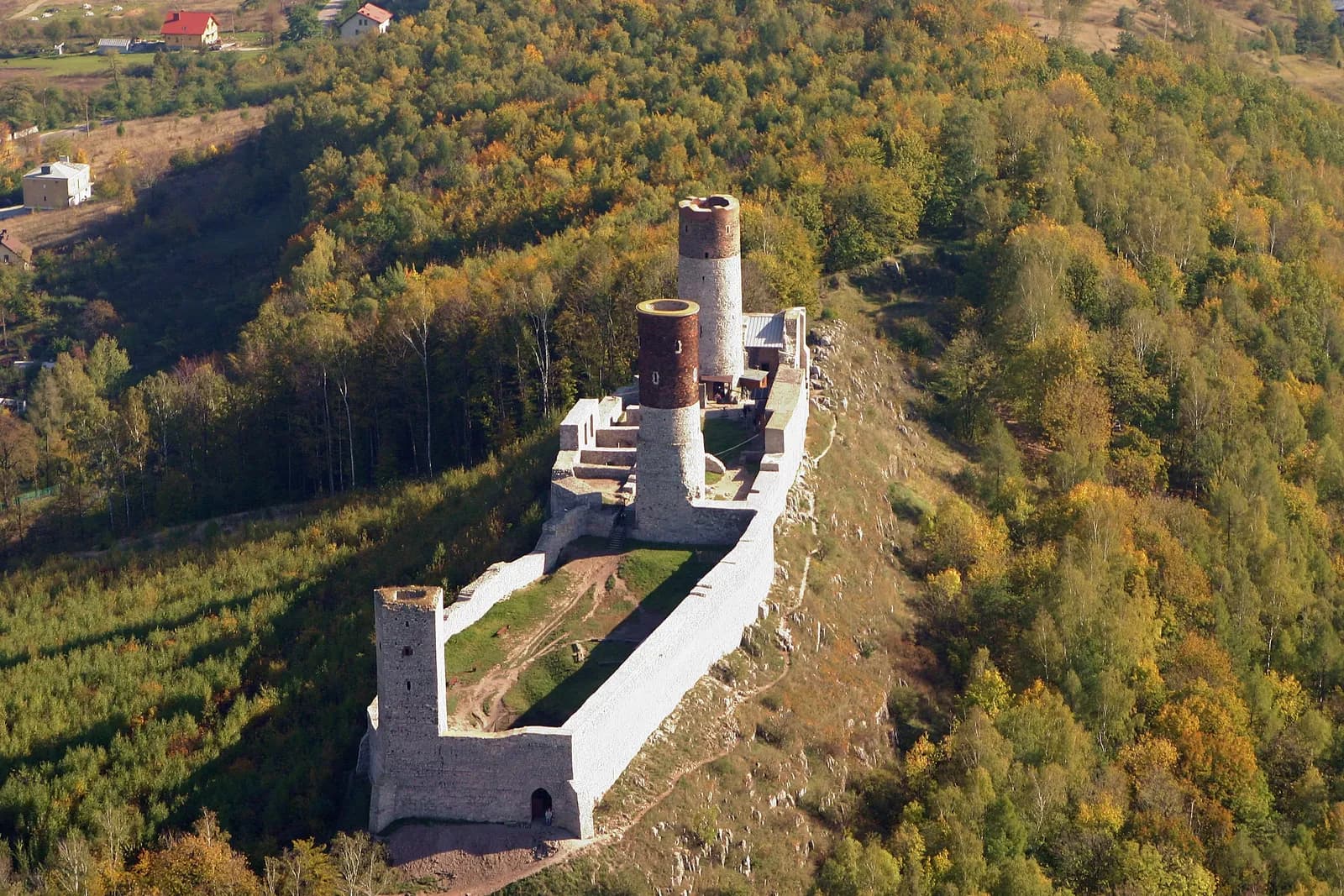
Rising above the town of Chęciny in the Świętokrzyskie Voivodeship, near Kielce, Chęciny Castle occupies a hill that has long given the stronghold both visibility and defensive advantage. Its surviving towers and walls now form a permanent ruin, but the history contained within them reaches back to the turn of the 13th and 14th centuries.
The exact circumstances of the castle's construction remain uncertain. Existing documents indicate that work on the stronghold had begun by the late 13th century, while archaeological discoveries have raised the possibility of an even earlier phase. Excavations carried out in 2013 uncovered the foundations of a previously unknown tower. According to archaeologist Waldemar Gliński, it may represent the oldest surviving element of the castle and was built on the initiative of Wenceslas II of Bohemia.
By 1306, the castle was established enough to become part of a significant political struggle. Władysław the Elbow-high granted the stronghold to the Bishop of Kraków, Jan Muskata, before revoking the privilege a year later under the pretext of uncovering a conspiracy against royal authority.
For Władysław, Chęciny became far more than a defensive site. The administration of his extensive estates was moved there from Małogoszcz, turning the castle into an economic, political and military centre. Assemblies of magnates and knights from Lesser and Greater Poland were held at Chęciny in 1310, 1318, 1331 and 1333. The stronghold also became a gathering point for troops preparing for war with the Teutonic Knights.
Its strategic importance extended beyond military affairs. In 1318, the treasury of the Archdiocese of Gniezno was deposited at the castle because its inaccessibility offered protection from the Teutonic Knights. In 1331, forces assembled there before the campaign associated with the Battle of Płowce.
From royal fortress to place of confinement
After Władysław the Elbow-high's death, Casimir the Great transformed Chęciny into a royal fortress. The castle was expanded considerably, including the raising of its stone towers, and for more than 250 years it remained an important stronghold.
Its royal connections continued over the following generations. Among those associated with the castle were Casimir the Great's second wife Adelaide, his sister Elżbieta Łokietkówna, Władysław Jagiełło's wife Zofia Holszańska and her son Władysław of Varna, and Sigismund the Old's wife Bona.
The castle also acquired a darker role as a state prison. Prisoners included Andrzej Wingold, Władysław Jagiełło's half-brother, Warcisław of Gotartowice and important prisoners taken after the victory at Grunwald, including Michał Küchmeister, who later became Grand Master of the Teutonic Order.
Yet the fortress could not escape the changes that eventually overtook it. During the 16th century it began to deteriorate. The Zebrzydowski Rebellion in 1607 brought further destruction, with fortifications damaged and buildings burned. Reconstruction followed, but the castle was again devastated between 1655 and 1657, first by Swedish forces and then by Rákóczi's troops. Another Swedish occupation in 1707 completed the process, after which the last inhabitants left.
For centuries, the abandoned walls became a source of building material for local residents. The decline continued into the modern era. During the First World War, Russian soldiers used the central tower as an observation post, causing damage, while during the Second World War, stone from the castle hill was used to harden surrounding roads.
Preserving what survived
The story of Chęciny Castle did not end with its destruction. Concern for the ruins emerged long before modern conservation programmes. The first conservation works were undertaken in 1877, while Julian Ursyn Niemcewicz had already described the deteriorating fortress in his Historical Travels in 1811.
The ruins also attracted the attention of writers including Stefan Żeromski and Henryk Sienkiewicz. In the interwar period, Chęciny's mayor Edmund Padechowicz played an important role in protecting the remains despite limited funding. After the Second World War, the towers were restored, with one adapted as a viewing point.
More recent conservation work has sought to preserve the castle as a permanent ruin. Revitalisation began in spring 2013 and continued until 2015, alongside archaeological investigations that revealed the previously unknown tower.
The physical structure itself remains a record of changing needs and technologies. Built on a levelled stone surface, the original castle followed an irregular polygonal plan adapted to the hill. Its courtyard was enclosed by walls around nine metres high, while the fortress was divided into an upper castle and a lower section known as the Przygródek.
Local grey limestone forms much of the surviving masonry, alongside sections of sandstone and brick. A well, carved into the rock to an estimated depth of 100 metres, remains one of the site's most intriguing features. A 1569 survey recorded efforts to secure a water supply inside the castle, although the theory that the well provided access to water has not been finally confirmed.
Today, the surviving walls do not tell a single story. They represent royal authority, military preparation, imprisonment, destruction and, ultimately, preservation. Chęciny Castle's significance lies precisely in that accumulation of history, with each generation leaving another layer on the hill above the town.