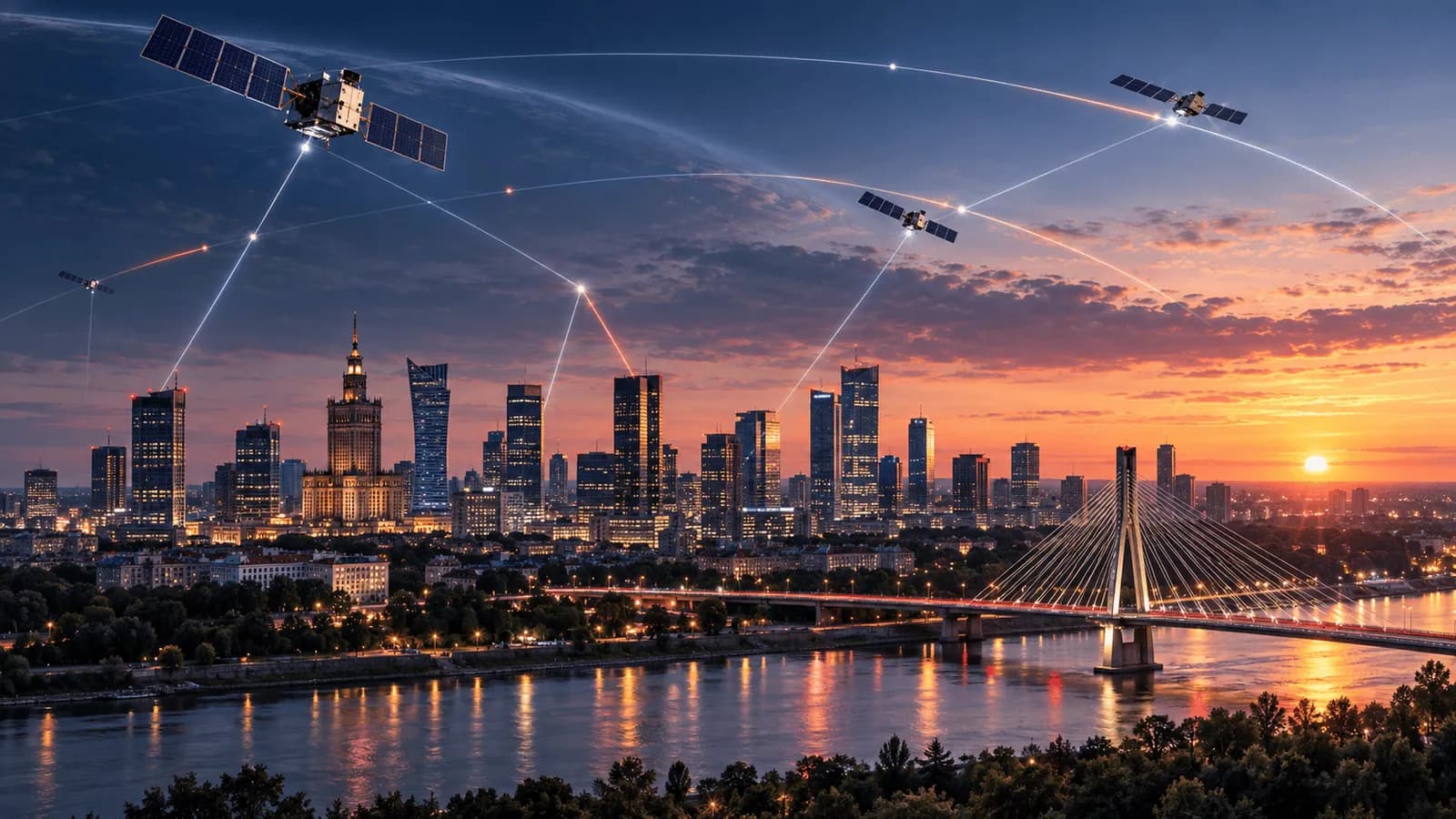
As the defence and technology world gathers in Kielce for this year’s MSPO International Defence Industry Exhibition, Poland’s ambitions are extending far beyond the systems on display inside Targi Kielce. Europe’s next generation of secure satellite infrastructure is now moving from planning towards production, and Poland is positioning itself close to the centre of that transformation. With 2.8 billion złoty committed to the European IRIS² satellite programme, the country is making a major bet on space communications, technological independence and a new generation of Polish expertise that could support both national security and the wider economy.
Europe’s race to build its own resilient satellite infrastructure has moved from political ambition towards engineering reality, and Poland is positioning itself near the centre of it.
Fresh agreements announced at the International Space Summit in Paris this week have formally started development of the first satellites for IRIS², the European Union’s secure communications constellation. Airbus has begun work on the first low-Earth-orbit spacecraft, while Thales Alenia Space has secured an agreement covering secure governmental payloads for hundreds of satellites.
For Poland, the development carries particular significance.
Warsaw has already committed 2.8 billion złoty, approximately €656 million, towards the programme and plans to finance the construction of more than a dozen satellites. The agreement was formally signed in Warsaw on 21 July by Interior Minister Marcin Kierwiński and European Commissioner for Defence and Space Andrius Kubilius.
It has inevitably been described in shorthand as a European, or even Polish, answer to Elon Musk’s Starlink.
That comparison is useful, but only up to a point.
What Poland is helping to build could become considerably more important than simply another way of getting broadband from space.
Poland is becoming an owner, not simply a user
The most significant part of Poland's involvement is perhaps not the number of satellites.
It is the change in Poland's position within the space economy.
Instead of buying connectivity entirely from a foreign commercial operator, Poland will participate in infrastructure being designed around European governments, businesses and strategic services.
IRIS² stands for Infrastructure for Resilience, Interconnectivity and Security by Satellite. It is intended to provide secure communications for governments and critical infrastructure while also supporting commercial connectivity.
The latest plans envisage a multi-orbit network including hundreds of satellites. Thales Alenia Space says the low-Earth-orbit component it is working on will include 330 spacecraft, while Airbus has begun development of an initial layer of at least 66 satellites scheduled for delivery in 2029.
This week therefore matters because IRIS² is increasingly moving beyond policy announcements and into actual industrial contracts.
That distinction is important.
Poland does not currently have a Polish equivalent of Starlink operating above the country. Nor is Warsaw independently launching thousands of internet satellites.
Instead, Poland has bought itself a significant role in a much larger European system and is seeking to ensure that Polish companies participate in building the technology around it.
For Poland's growing technology sector, that could prove far more valuable in the long term.
Why Starlink changed the conversation
Satellite communications were once relatively easy for the public to ignore.
Starlink changed that.
By placing thousands of relatively small satellites in low Earth orbit, or LEO, SpaceX dramatically reduced the delays traditionally associated with satellite internet.
Older communications satellites commonly orbit tens of thousands of kilometres above Earth. Starlink satellites fly much closer, meaning data has a considerably shorter journey between a user's terminal, a satellite and the wider network.
The result is satellite connectivity capable of supporting activities that would previously have been difficult through traditional satellite systems.
And events in Ukraine demonstrated something even more important.
Space-based internet is no longer simply a convenience for remote homes or ships at sea. It can become essential national infrastructure.
Governments have consequently begun asking an uncomfortable question: what happens when strategically important communications depend upon infrastructure controlled by a company outside your country?
Europe's answer is increasingly to build more of its own.
Reuters reported this week that European governments and the European Space Agency are pushing for greater coordination of sovereign satellite programmes, while the EU's IRIS² network is intended to reduce Europe's dependence on non-European systems.
For Poland, situated on NATO's eastern frontier, the argument for resilient communications is particularly powerful.
A €656 million Polish bet on space
Poland's financial commitment is substantial.
The government says 2.8 billion złoty for its participation will come through Poland's National Recovery Plan.
The investment is expected to finance more than a dozen satellites associated with the IRIS² programme while securing access to the resulting communications infrastructure.
When the deal was announced in Warsaw, Commissioner Kubilius described Poland's involvement as an investment in security, the economy and the country's future, saying Poland could become a pillar of Europe's secure communications strategy.
There is a practical civilian case too.
During major floods, fires, power failures or other disasters, terrestrial mobile and fibre networks can themselves become casualties.
Polish officials have specifically pointed to the September 2024 floods as an example of circumstances in which independent satellite communications could help emergency services remain connected.
Satellite connectivity therefore provides something different from simply faster internet.
It creates another route into the communications network when the infrastructure on the ground is damaged, congested or unavailable.
An opportunity for Polish technology companies
This is where the project becomes particularly interesting for Warsaw's technology economy.
Poland's agreement is not intended simply to result in money being transferred to large aerospace companies elsewhere in Europe.
A subsequent memorandum between Poland and Eutelsat, one of the companies at the heart of the SpaceRISE consortium delivering IRIS², specifically set out plans to involve the Polish space ecosystem.
Polish companies are expected to gain access to Eutelsat facilities for developing and testing future IRIS² user terminals. The two sides have also discussed reserving capacity on the existing OneWeb low-Earth-orbit network for Poland before IRIS² becomes operational.
That matters because a satellite network is considerably more than the spacecraft themselves.
There are antennas and terminals.
Ground stations.
Secure communications systems.
Cloud infrastructure.
Data processing.
Cybersecurity.
Satellite electronics.
Optical systems.
Software for controlling constellations containing hundreds of moving spacecraft.
And eventually applications built on top of all of them.
A successful European programme therefore has the potential to create an entire supply chain.
Poland already has companies capable of competing within it.
The country has been steadily developing expertise in small satellites, Earth observation, electronics and space software. Projects including PIAST, CAMILA and Polish-developed satellite platforms are creating experience that would have seemed considerably more ambitious for the country's space industry little more than a decade ago.
IRIS² potentially gives that ecosystem a much larger market.
Warsaw could benefit from the space economy without building rockets
When people think about national space industries, it is tempting to imagine rockets and launch pads.
But much of the economic value of the modern space industry is created on Earth.
Warsaw is particularly well positioned in areas such as software development, artificial intelligence, cybersecurity, telecommunications, cloud computing and defence technology.
These are increasingly inseparable from satellites.
A modern satellite may be flying hundreds of kilometres above Earth, but the systems interpreting its data, managing customers, allocating bandwidth, detecting cyberattacks and coordinating the network can be developed from an office in Warsaw.
That changes what being a "space nation" means.
Poland does not need to recreate SpaceX in order to develop a serious space technology sector.
It needs Polish engineers and companies to own valuable parts of the technology stack.
IRIS² provides a potential route towards exactly that.
So is this really a Polish Starlink?
Not exactly, and describing it accurately makes Poland's involvement more impressive rather than less.
Starlink is a vertically integrated commercial network created and operated by SpaceX. It already has thousands of satellites in orbit and offers consumer broadband across much of the world.
IRIS² is a European public-private project with different priorities.
Its principal selling points include security, resilience and European control, with connectivity being provided to governments as well as commercial customers.
It is also being designed as a multi-orbit network, rather than simply attempting to reproduce Starlink satellite for satellite.
SpaceRISE brings together major European operators including Eutelsat, SES and Hispasat, while companies including Airbus and Thales Alenia Space are involved in construction.
Europe already has one substantial LEO network through Eutelsat's OneWeb, which operates more than 600 satellites and concentrates largely on governments, businesses and telecommunications customers rather than competing directly with Starlink for every household. Eutelsat announced another order for 229 OneWeb satellites this week as it expands the network ahead of IRIS².
So rather than "Polish Starlink", it may be more accurate to think of Poland as helping build Europe's sovereign satellite communications layer.
That could ultimately be the more strategically important project.
Europe is suddenly serious about space
The timing is significant.
For years, Europe has possessed world-class aerospace engineering while allowing American companies to take the lead in several rapidly expanding commercial space markets.
That balance is beginning to shift.
At the Paris summit this week, European leaders and industry executives discussed increasing the continent's ability to operate independently in space.
Airbus has now started developing the first IRIS² spacecraft. Thales Alenia Space has announced an agreement worth around €500 million covering secure payloads for 330 LEO satellites, part of a larger IRIS² contract it says could eventually exceed €3 billion.
Meanwhile, the wider programme is expected to run into many billions of euros as Europe constructs satellites, launches them, builds ground infrastructure and develops secure services.
Recent discussions have extended even further, towards satellite connections that could communicate directly with ordinary mobile phones.
Major European telecom operators including Deutsche Telekom, Orange, Vodafone and Telefónica have reportedly been discussing cooperation around satellite-to-mobile services and European spectrum.
Put together, these developments suggest Europe is moving towards something larger than an isolated satellite project.
It is beginning to assemble its own communications ecosystem in orbit.
Poland has made sure it has a seat at the table.
The hard part begins now
There is still reason for realism.
Building a satellite constellation is extraordinarily difficult.
Starlink's scale was made possible partly because SpaceX controls its own rockets, satellite production and much of the ground technology supporting the system.
Europe's model involves governments, European institutions and numerous companies spread across multiple countries.
That brings industrial diversity, but it also creates complexity.
Europe will have to coordinate manufacturing, frequencies, launches, ground stations, cybersecurity standards and services while keeping a multi-billion-euro programme on schedule.
The first IRIS² satellites are expected towards the end of the decade, meaning the service should not be mistaken for something Polish consumers will be able to order next month.
Recent reporting from the Paris summit suggests the full system is likely to develop into the early 2030s.
For Poland, another test will be how much of its financial contribution translates into meaningful domestic technological capability.
Buying satellites is useful.
Helping design their electronics, terminals, software and services would be better.
Developing Polish companies capable of exporting those technologies across Europe would be better still.
That should ultimately be one of the measures of the programme's success.
Poland's space ambitions are becoming tangible
Something significant has nevertheless changed.
Poland's relationship with space technology is increasingly moving from experimentation towards infrastructure.
It is developing Earth-observation capabilities.
Polish satellites are reaching orbit.
Domestic businesses are building increasingly sophisticated space hardware and software.
The country has substantially increased its involvement with the European Space Agency.
And it is now committing billions of złoty to one of Europe's most ambitious communications projects.
None of this means Poland is about to replace Starlink.
It means something potentially more durable is happening.
Poland is beginning to participate in the construction of the infrastructure on which the next generation of European digital services may depend.
For a country with a large engineering workforce, a fast-growing technology industry and obvious strategic reasons to value communications resilience, that is a considerable opportunity.
The satellites themselves may eventually orbit hundreds or thousands of kilometres above Warsaw.
But many of the technologies, businesses and jobs they create could be built much closer to home.
And that is why Europe's emerging satellite network deserves to be viewed not simply as another defence project, but as an opportunity for Polish technology to move into orbit.
Image credit: AI-generated illustration created for Kielce Magazine.